A Short History
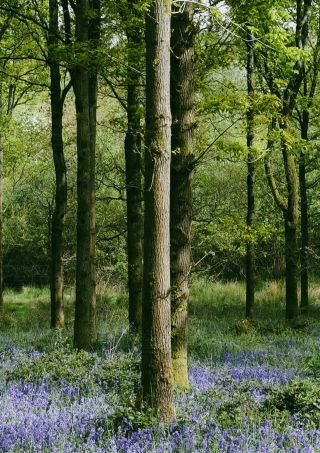
“Rhinefield…..Where some antique oak, itself a grove,
spreads its soft umbrage o’er the sunny glade”
(William Wordsworth 1793)
Although Rhinefield House has existed in its present form since the 1880’s there have been
dwellings on the site since the “New Forest” was first proclaimed by William the Conqueror in about
1097. To him the forest represented an area, conveniently close to his capital of Winchester,
in which he could pursue his favourite sport of hunting. The creation of a Royal hunting
preserve placed the area under “Forest Law” which curtailed the liberty of the indigenous peasants
and threatened drastic punishment for interference with the potential quarry or their
environment. Since this law precluded fencing, which would obstruct the free run of the game,
domestic animals were allowed extensive grazing rights, which exist to this day. The forest
was divided for administrative purposes into areas and “walks” each supervised by a keeper (an
office rather more exalted than its modern equivalent). Keepers lived in a series of lodges,
of which Rhinefield was the first to be built in 1709. The use of the Forest as an exclusive
hunting ground waned during the reign of Charles II and the office of
"Keeper of the Walk" became a Grace and Favour
appointment. By 1859 Rhinefield, which had been the site of a succession of keepers’ lodges,
had become the abode of a Forest Nurseryman who was responsible for the creation of the Ornamental
Drive and the planting of many conifers in the Rhinefield grounds.
In 1877, many of the Crown Lands were
“privatised”. Grace and Favour appointments lapsed
and vacant lodges were leased to private individuals. Rhinefield passed to the hands of the Walker
family, who owned Eastwood Colliery, immortalised in the novels of D.H. Lawrence. In 1885 the
only daughter of the family became engaged to a Lieutenant Munro RN, and her father’s engagement
present was £250,000 with which to build a family home at Rhinefield. After their marriage in
1887 the couple adopted the name Walker-Munro and supervised the construction of an impressive
country seat comprising the Great House, a Hunting Lodge, Stables, Gardener’s Bothy and a Gate
Lodge. (There was even enough change left over to build a modest “beach-hut” which is best
known today as the White House at Milford on Sea).
The Great House contains four suites for the four daughters who were part of the family plan,
to which Mother Nature was unfortunately not privy, since the lady of the house gave birth to a son
in 1889. Her frustration, aggravated by the news that she could not bear another child, was to
be a dominant influence on the family’s future. The mother took little part in her unfortunate
son’s early upbringing, which was left largely to servants. After a public school education
and service with the Army in France during World War 1, Major Ian Walker-Munro emigrated to Kenya
to become a farmer with financial assistance from his father. He married in 1919 and had four
sons. Controversy seemed to follow the Walker-Munro family. For example, they styled
themselves
“Lord of the Manor at Rhinefield”, a wholly fictitious
title which bought them into conflict with another local family, the Morants, who were official
Lords of the Manor of Brockenhurst and Rhinefield. Their mutual antipathy even extended to a
refusal to worship in the same church and, in 1903, the Walker-Munros decided to build a church of
their own (now St Saviour’s by the Watersplash in Brockenhurst). However this venture was
short lived as Mrs Walker-Munro quarrelled with the incumbent, a relative whom they had themselves
installed in the living, and work ceased. The full significance of this only became apparent
on the death of her husband in 1923. The church, being unfinished, was not licensed for
burials so, rather than let him lie near the Morants, she buried him in a copse on Ober farm, which
at the time was the home farm.
Mrs Walker-Munro was now a very wealthy woman and became the benefactress of many charities,
to which she intended to leave her fortune to the exclusion of her estranged son. However,
even this plan misfired. Having revoked one will and not yet signed its replacement, she died,
effectively intestate and the unthinkable happened – the whole estate passed to her
son. Frustrated to the end, she joined her husband in the Ober Farm in 1934. Rhinefield
remained in the possession of her family until after the death of her son in 1950, when crippling
death duties forced his widow to dispose of it.
There followed a period of uncertainty for Rhinefield, during which several schemes for
conversion to flats or a hotel foundered for one reason or another, and the one relatively
successful venture was a private school which occupied the house for ten years. In 1972 Mr
Oliver Cutts, who made considerable progress in refurbishing the house and grounds, but whose plans
did not win approval of the local planning authority, bought the freehold. So in 1982
ownership passed to the Nicholas Hotels whose plan to develop Rhinefield into a hotel with
conference facilities and several luxury apartments, to be leased on a timeshare basis, was
successful. This was followed in 1989 by transfer of ownership to Richard Branson (Virgin
Hotels), and an upgrading programme was begun. The oldest part of the house appears to be the
fire-back in the central Grand Hall, which bears the date 1653. The previous lodge was
demolished to make way for the present house, although the materials were carefully preserved and
used in the construction of the present hunting lodge.
The Great House designed by architects Romaine-Walker and Tanner of London, incorporates a
mixture of styles, both externally and internally, reflecting the personal tastes which the
Walker-Munros acquired in their travels. Thus Tudor combines with Gothic architecture, while
inside, the Grand Hall has many features of the Westminster Hall and the master’s smoking room
reproduces the splendour of the Alhambra Palace in Granada. Opinions of this mixture vary, but
there can be no doubting the craftsmanship that went into the construction. The house abounds
with supreme examples of the art of wood carvers, stone masons, sculptors, plasterers, coppersmiths
and even loo makers! The Alhambra room alone took the Spanish workmen, who were bought over
specifically for the purpose, two years to build. Other notable features are the Armada
carving by Aumonnier with a surrounding by Grinling Gibbons, a ceiling canvas by Fragonnard, and
the magnificent wood panelling throughout the house and the Orchestration, which occupies the organ
loft in the Grand Hall.
Most of the original features of the house have been retained during the refurbishment and
conversion. The Armada is now the Restaurant while the Alhambra forms an extension to the
Armada. The principal bedrooms of the house are now two luxurious suites, and the timeshare
apartments which occupy the east wing formerly comprised of the daughter’s and guest suites and
servant quarters. The hotel accommodation occupies a wing to the west of the house. The
grounds of Rhinefield are also a mixture, informal woodland in which native forest trees jostle
with more spectacular imports such as the giant redwoods, and the formal terraces, lawns and water
features reminiscent of the great French and Italian gardens. Part of the refurbishment
programme has been the reinstatement of the gardens to their original splendour, helped and
encouraged by the Hampshire Garden Trust which fortunately has plans and photographs of the
original layout.
The present owners, Hand Picked Hotels, are confident that, with the completion of the planned
programme of refurbishment and modification, they will have achieved the twin aims of restoring
Rhinefield House to a condition worthy of its magnificent New Forest setting, while providing
unrivalled facilities for both business and pleasure in luxurious surroundings.
Rhinefield House, Brockenhurst. The name means Badger
Wood and it is set in the midst of beautiful Crown Forest land and is approached from the main A35
road, Southampton to Bournemouth, by the delightful Ornamental Drive famous for its colourful
Azaleas and Rhododendrons. A large Master Keeper’s Lodge stood in Rhinefield Walk, and in 1628
the records show that the Earl of Holland authorised a sum of money to the Woodward (H.M. Keeper of
the Timbers) to carry out work on the Great Rhinefield Lodge as it was then called. In 1789,
Colonel Haywood, Deputy Warden, occupied the lodge and spent a considerable amount of money on
improvements. Eventually Lieutenant Walker-Munro R.N turned the old nursery into pleasure
grounds and built the present lovely mansion.
The Alhambra Smoking Room
The Alhambra Room, of breathtaking beauty, is an exact copy of the Alhambra Palace in Granada,
recreated here by Mabel Walker-Munro as a Christmas present for her husband. During their honeymoon
he had so admired the then ruined Alhambra that she was determined to recreate this room for his
own private use as a smoking room. She therefore instructed her architects to set out and gather
materials, including onyx from Persia and coppersmiths of Moorish origin, who were capable of
recreating, in England, this unique room. High in the dome one sees beautiful stars in the
Venetian glass forming the Star of David. One could liken the vast dome itself to the breast
feathers of a peacock. Below is a bronze grille. This was once part of the first
air-conditioning of the house, which could either blow hot or cold air, pumped by the great gas
engines. The walls of beaten copper with a gesso finish bear the inscriptions
"There is no God but God and Mohammed is his prophet", "God loves
all men and loves a true believer" and
"The heavens and the earth testify to the magnificence of
God". The beautiful mosaic floors with onyx pillars tell the story of how the great and
good Caliph Harmoum Al Rashid of Baghdad, by making magic from the pentacle (which is seen in the
centre of the floor), rescued his twin daughters from the clutches of Ahnzar the Devil who had
turned them into flamingos. The magnificent copper and bronze lantern is the full Ruaiyat of
Omar Khayyam, both in cameo and intaglio, and on the base a comet whirling through space shows how
God created the world, for if one looks, there are six appendages. In six days God created the
world and on the seventh he rested. Opposite the doors, the tapestry work of the fine Kalim
prayer carpets every stitch a prayer. The doors to the room are inlaid with brass telling the
same story as is told in the floor. The tiles on the walls are hand cut and burnt and each
show flowers and other symbols of religious significance.